What Is the American Progress Mural? A Deep Dive Into Art, History, and Cultural Meaning
John Gast’s American Progress stands as one of the most iconic yet misunderstood images in American art history. Created in 1872, this monumental painting captures a moment of national ambition, westward expansion, and the complex ideologies that shaped a young nation. Yet for all its prominence in textbooks and historical discussions, many people encounter it without truly understanding its layers of meaning, historical context, or the fierce debates it continues to inspire.
The mural represents far more than a simple depiction of settlers moving west. It’s a visual manifesto of 19th-century American ideology, a reflection of the era’s optimism mixed with troubling assumptions about progress, civilization, and manifest destiny. Understanding this artwork requires us to look beyond the surface imagery and examine the historical forces that created it, the artist’s intentions, and how modern perspectives have reframed our interpretation of this complex cultural artifact.
Whether you’re an art enthusiast, history student, or simply curious about American culture, this exploration will help you grasp why this single painting remains so relevant and contested more than 150 years after its creation.
The Origins and Creation of American Progress
John Gast, a German-American painter born in 1830, created American Progress during a pivotal moment in American history. The painting emerged just two years after the completion of the first transcontinental railroad, an achievement that symbolized America’s technological advancement and continental ambitions. Gast didn’t create this work in isolation; he was responding to the cultural zeitgeist of the 1870s, a period when Americans were actively reimagining their national identity.
The original painting measures approximately 4.5 by 7 feet, making it a substantial work intended to command attention and inspire reflection. Gast worked in the tradition of American romantic landscape painting, a genre that emphasized the sublime beauty of nature while often incorporating allegorical elements. The painting was commissioned for reproduction as a colored lithograph, which allowed it to reach a far broader audience than the original canvas alone could achieve.
What makes Gast’s creation particularly interesting is how it synthesized popular beliefs of its time into a single, coherent visual narrative. The artist drew inspiration from contemporary political rhetoric, popular literature, and the visual conventions of American art. He wasn’t inventing these ideas; rather, he was crystallizing them in pigment and canvas. This process of artistic translation reveals how deeply embedded certain ideologies were in American culture during the post-Civil War era.
The painting’s commission and distribution reflected the economic and cultural priorities of the period. Publishers and patrons recognized its propaganda value—the ability to communicate complex ideas about national progress to an increasingly literate and visually-engaged American public. In this sense, American Progress functioned as a form of visual communication not unlike modern advertising or political messaging.
Understanding the context of advancing school mental health through education and awareness, we can draw parallels to how art educates society about its own beliefs and values. Gast’s work serves as a historical document that reveals what Americans of that era believed about themselves and their nation. When we examine advances in how we understand cultural narratives, we recognize that art functions as a powerful educational tool that shapes collective consciousness.

Decoding the Visual Symbolism
The composition of American Progress operates on multiple symbolic levels, each element carefully chosen to communicate specific messages to viewers. At the center stands Columbia, a feminine allegorical figure representing the United States herself. She’s depicted as a classical goddess, draped in flowing white robes and crowned with a halo of light, emphasizing her almost divine status and moral superiority.
Columbia moves from right to left across the canvas, literally progressing westward. She carries a schoolbook in one hand and telegraph wire in the other—symbols of education and technological advancement. Her bare feet seem to tread upon the wilderness itself, suggesting both dominion and transformation. The light emanating from her figure casts shadows over the landscape to the right, with darker areas representing the untamed wilderness and indigenous peoples being pushed into obscurity.
Behind Columbia, settlers and pioneers follow her lead, spreading across the landscape with horses, wagons, and farming implements. They represent the American people, following the divine guidance of the nation’s destiny. The imagery of settlement and cultivation—fences being erected, fields being plowed, towns being built—demonstrates the transformation of “wild” land into civilized, productive territory. This visual progression from wilderness to civilization forms the painting’s central narrative arc.
To the right of the composition, where the light grows dimmer, we see Native Americans and wild animals fleeing westward, seemingly retreating before Columbia’s advance. Buffalo herds scatter, and indigenous figures appear diminished and displaced. This element of the painting reveals the most troubling aspect of Gast’s work: the casual erasure of existing peoples and cultures in the name of progress. The painting presents this displacement not as tragedy but as inevitable, even natural, consequence of historical advancement.
The landscape itself transforms across the canvas. On the right, we see mountains, deserts, and untamed wilderness. Moving leftward toward the viewer, the landscape becomes increasingly developed—towns appear, steamships navigate rivers, and the infrastructure of civilization multiplies. This spatial arrangement reinforces the temporal narrative: progress moves from west to east in the painting’s composition, even though the historical settlement pattern moved from east to west.
Every detail in the composition serves the overarching message: America is destined to expand, civilization must replace wilderness, and this transformation represents moral and material progress. The painting leaves no room for alternative interpretations or competing values. It’s a totalizing vision, one that demands acceptance of its premises.
Historical Context: The Era of Manifest Destiny
To truly understand American Progress, we must situate it within the ideology of manifest destiny—the widespread belief that American expansion across the continent was justified, inevitable, and divinely ordained. This concept gained prominence in the 1840s but reached its apex during the period when Gast created his painting.
The Civil War had just concluded, and the nation was grappling with questions about its identity and future direction. The completion of the transcontinental railroad in 1869 seemed to validate the manifest destiny philosophy: technology had conquered geography, and America had literally connected its coasts. For many Americans, this represented the fulfillment of national destiny and the triumph of civilization over nature.
The ideology underlying manifest destiny contained several troubling assumptions. First, it posited a hierarchy of civilizations, with American civilization standing at the apex. Second, it justified the displacement and subjugation of Native Americans as a necessary consequence of historical progress. Third, it framed westward expansion not as a political choice but as a natural, almost biological imperative. Gast’s painting crystallizes all these assumptions into visual form.
The post-Civil War period also saw intense debates about the meaning of American progress. The nation had just survived a devastating internal conflict that challenged fundamental assumptions about American unity and destiny. Some Americans saw westward expansion and continental development as a way to redirect national energy toward external growth rather than internal conflict. Others viewed it as a continuation of the expansionist impulse that had characterized American foreign policy since its founding.
During this era, the concept of progress as a work in progress reflected American confidence in technological and social advancement. The railroad, telegraph, and industrial manufacturing seemed to prove that American innovation could overcome any obstacle. This technological optimism infused national consciousness and found expression in artworks like Gast’s mural.
Educational institutions, including schools focused on progress and advancement, began incorporating this historical narrative into their curricula, cementing manifest destiny ideology in American educational consciousness for generations to come.
The Mural’s Journey Through American Culture
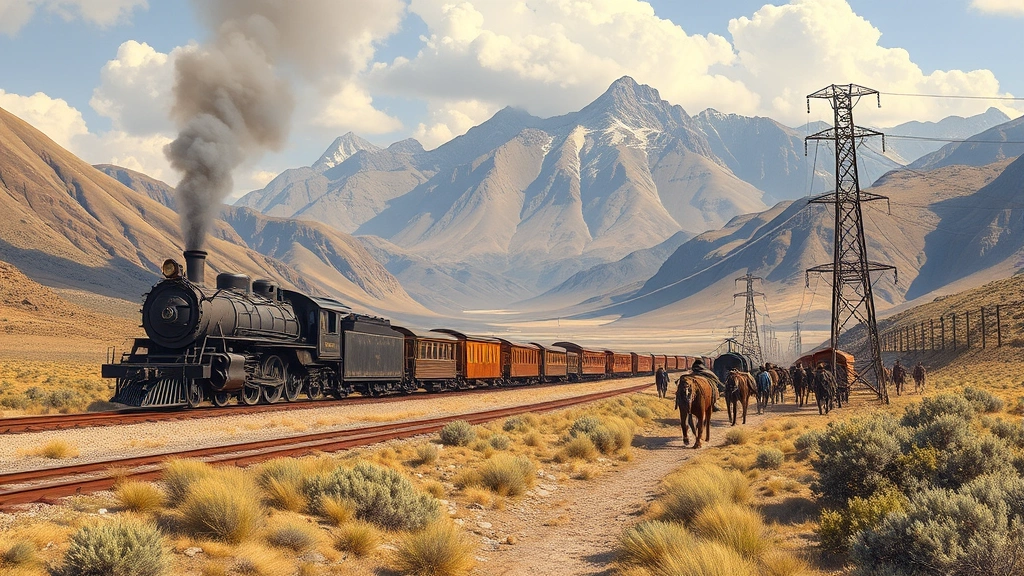
After its initial creation and lithographic reproduction, American Progress became one of the most widely distributed images in American history. The colored lithograph versions reached classrooms, government offices, homes, and public institutions across the country. Its accessibility and striking visual power made it an ideal tool for communicating national ideology to populations with varying levels of education and literacy.
Throughout the late 19th and early 20th centuries, the image became increasingly embedded in American consciousness. It appeared in textbooks, on calendars, in newspapers, and eventually in digital form across the internet. Each reproduction potentially reached new audiences and reinforced the ideological messages encoded within the composition. The painting functioned as a kind of visual propaganda, one so familiar and seemingly innocent that its ideological content often went unexamined.
During the era of westward expansion’s completion—roughly the 1890s through 1920s—the painting served as a nostalgic reminder of American achievement and destiny. Even as the frontier officially closed and the nature of American expansion shifted, the image persisted as a symbol of national identity and historical accomplishment.
The mid-20th century saw renewed interest in the painting as Americans grappled with their role in global affairs and their national identity during the Cold War. Some viewed it as a historical artifact documenting American ideals; others began questioning the values it represented. This period marked the beginning of more critical reexamination of the work and its underlying assumptions.
Modern scholarship has examined how the painting’s circulation shaped American historical consciousness. Agricultural progress and development, often presented as parallel to westward expansion, reinforced similar narratives of civilization advancing over nature and tradition.
Modern Criticism and Reinterpretation
Contemporary art historians, Native American scholars, and critical theorists have fundamentally reframed how we interpret American Progress. Rather than accepting the painting’s explicit message, modern analysis interrogates the assumptions underlying its composition and asks difficult questions about what’s hidden within its seemingly clear narrative.
One major line of criticism focuses on the erasure of Native Americans and indigenous perspectives. The painting presents indigenous peoples as passive figures fleeing before civilization’s advance, denying them agency, complexity, or legitimacy. Modern interpretations recognize that Native Americans had sophisticated societies, established legal systems, and deep knowledge of the land. The painting’s casual dismissal of these realities reveals the violence inherent in manifest destiny ideology, even when expressed in supposedly inspiring artistic form.
Scholars have also examined the gendered representation in the work. Columbia, the feminine allegorical figure at the painting’s center, embodies both nurturing and dominating characteristics. She guides settlement and development, but she also represents a kind of violated nature—the landscape itself is feminized and subjected to masculine conquest. Feminist art historians have argued that the painting conflates the subjugation of women with the subjugation of nature and indigenous peoples, revealing interconnected systems of domination.
Environmental historians have offered additional critiques, pointing out that the painting presents ecological transformation—the replacement of diverse ecosystems with monoculture agriculture and urban development—as unambiguously positive. Modern environmental consciousness recognizes that this transformation involved significant ecological loss and the destruction of complex natural systems. The painting’s triumphalist framing obscures these environmental costs.
Research into the advances and breakthroughs in understanding historical trauma has also influenced interpretation of American Progress. Scholars recognize that the processes depicted in the painting—displacement, cultural destruction, and forced assimilation—had devastating psychological and social consequences for indigenous populations that reverberate through generations.
These modern reinterpretations don’t necessarily condemn Gast as an artist; rather, they contextualize his work as a product of its era while refusing to accept its ideological premises uncritically. This approach allows us to learn from historical documents without endorsing their values.
Legacy and Ongoing Relevance
More than 150 years after its creation, American Progress remains relevant precisely because it continues to provoke debate and reflection about American identity, progress, and values. The painting serves as a mirror reflecting both what Americans believed about themselves in the 19th century and what modern Americans make of those historical beliefs.
In contemporary discourse, the image appears in discussions about American exceptionalism, the costs of development, indigenous rights, and environmental stewardship. It functions as a visual anchor for complex historical conversations, allowing people to engage with abstract concepts through concrete imagery. When people encounter the painting today, they’re often struck by the gap between its triumphalist message and modern understandings of history and ethics.
The work has also inspired contemporary artists to create responses and reinterpretations. Modern artists have reimagined the composition from indigenous perspectives, environmental perspectives, and perspectives that center marginalized communities. These artistic responses demonstrate how American Progress continues to generate creative and intellectual engagement across generations.
Educational institutions continue to teach the painting, though with increasingly critical frameworks. Students learn not just what the painting depicts but how to analyze its ideological content, recognize propaganda techniques, and understand how historical narratives shape collective consciousness. This pedagogical shift represents a maturation in how we engage with historical artifacts.
Understanding American Progress requires the kind of focused analysis and critical thinking that modern scholarship emphasizes. The painting demands that we slow down, examine assumptions, and consider multiple perspectives—skills that extend far beyond art history into every domain of intellectual inquiry.
Frequently Asked Questions
Who painted the American Progress mural?
John Gast, a German-American painter, created American Progress in 1872. Gast was born in 1830 and worked primarily as a landscape and allegorical painter. The original painting measures approximately 4.5 by 7 feet and was subsequently reproduced as a colored lithograph for wider distribution.
Why is the American Progress painting controversial?
The painting is controversial because it depicts and celebrates westward expansion and manifest destiny while simultaneously erasing and marginalizing Native Americans. Modern interpretations recognize that the painting’s triumphalist narrative obscures the violence, displacement, and cultural destruction that accompanied American expansion. Contemporary scholars critique how it presents indigenous peoples as passive obstacles to civilization rather than as complex societies with legitimate claims to the land.
What does Columbia represent in the painting?
Columbia is an allegorical female figure representing the United States itself. She’s depicted as a classical goddess with a halo of light, carrying a schoolbook and telegraph wire. Her presence at the center of the composition emphasizes the divine nature of American progress and her role in guiding westward expansion and the transformation of the landscape.
How was American Progress used historically?
The painting was reproduced as a lithograph and distributed widely throughout American homes, schools, government offices, and public institutions. It functioned as a kind of visual propaganda, communicating ideologies of manifest destiny and American progress to broad audiences. The image appeared in textbooks, on calendars, and in various publications, making it one of the most widely distributed artistic images in American history.
How do modern scholars interpret American Progress differently?
Modern scholars examine the painting critically, interrogating its ideological premises rather than accepting its message at face value. They analyze how it erases indigenous perspectives, examine its gendered representations, consider its environmental implications, and recognize the violence embedded in its narrative of progress. This critical approach allows scholars to learn from the historical document while refusing to endorse its values.
Is the American Progress painting still relevant today?
Yes, the painting remains highly relevant. It continues to provoke discussions about American identity, the meaning of progress, indigenous rights, environmental stewardship, and historical accountability. The work serves as a visual reference point for understanding 19th-century American ideology and for examining how historical narratives shape contemporary consciousness. Contemporary artists continue to create responses and reinterpretations of the work.


